



Why Automated Dynamometer Testing Matters for OEM Engine Development and Validation
Improving Reliability, Compliance, and Test Cell Productivity in Industrial Test Environments
As engines, powertrains, and industrial systems become increasingly sophisticated, testing requirements continue to grow in complexity. OEMs, engine manufacturers, research organizations, and validation laboratories must generate highly accurate, repeatable data while accelerating development timelines and maintaining compliance with evolving regulatory standards.
Manual testing methods can provide valuable information, but they often introduce variability that impacts data consistency and repeatability. Operator reaction time, procedural interpretation, and environmental influences can affect results, making it more difficult to compare data across programs, facilities, and development cycles.
Automated dynamometer testing addresses these challenges by executing predefined test procedures with precise control over speed, torque, load, throttle position, and data acquisition parameters. The result is a more efficient testing process that improves data quality, standardization, and confidence in engineering decisions.

Key takeaway
For industrial testing organizations, automation is not simply a convenience feature. It is a foundation for repeatable validation data, standardized procedures, higher test-cell utilization, and faster development cycles.
The Four Core Benefits of Automated Testing
1. Simulation of Real-World Operating Conditions
To accurately reproduce real-world engine behavior on a dynamometer, transient testing capabilities are essential. Transient testing includes changes in speed, torque, throttle position, and load conditions that occur during actual operating scenarios such as acceleration, load acceptance events, towing, durability cycles, and changing duty cycles.
Unlike steady-state manual testing, transient testing involves multiple variables changing simultaneously. These events often occur too quickly and precisely to be controlled consistently by an operator. Automated testing systems execute these transitions under computer control with high repeatability.
For OEMs and industrial manufacturers, automated transient testing enables engineers to evaluate engine performance under operating conditions that closely replicate real-world duty cycles. This provides valuable insight into system behavior during acceleration, generator load acceptance, hydraulic demand changes, and other dynamic operating scenarios.
Common industrial applications include:
- Generator set load acceptance testing
- Construction equipment duty cycles
- Mining equipment operation
- Agricultural equipment load profiles
- Military vehicle mission profiles
- Marine propulsion applications
2. Standardization Across Test Programs
Once an automated test procedure has been developed, it can be consistently applied across multiple operators, facilities, and test environments while producing comparable results.
Automation minimizes differences caused by operator interpretation or inconsistent execution of test procedures. This level of standardization is essential in industries where accurate comparison data is required.
Typical applications include:
- OEM validation testing
- Production quality control
- Regulatory compliance testing
- Emissions certification
- Component durability verification
Standardized automated testing is particularly important for manufacturers operating multiple development centers, production facilities, or supplier validation programs. By ensuring every test follows the same procedure, organizations can confidently compare results across locations, programs, and product generations.
3. Improved Repeatability
Repeatability is one of the most important advantages of automated dynamometer testing.
An automated test executes the same sequence of events, timing intervals, control parameters, and data acquisition settings every time the procedure is run. By reducing human variability, automated testing improves confidence in the resulting data.
Repeatability is especially important when:
- Comparing component changes
- Evaluating calibration adjustments
- Conducting back-to-back testing
- Validating performance improvements
- Performing research and development
Repeatability is essential when validating design changes, comparing calibration revisions, or documenting compliance with customer and regulatory requirements. Automated testing reduces procedural variation and helps ensure engineering decisions are based on reliable, comparable data.
Highly accurate instrumentation alone cannot compensate for inconsistent test procedures. Reliable data requires both precision measurement and repeatable test execution.
4. Increased Productivity and ROI
Automation improves overall test cell productivity.
Predetermined test procedures can be loaded and executed quickly, reducing setup time and minimizing operator involvement during testing. This allows facilities to complete more tests in less time while maintaining consistency and accuracy.
Additional productivity advantages include:
- Faster test setup
- Reduced engineering labor
- Increased test cell throughput
- Improved test scheduling
- More efficient data collection
- Higher dyno utilization
- Faster validation cycles
- Reduced retesting caused by inconsistent procedures
In many facilities, test procedures can be developed offline on separate engineering workstations while the dynamometer remains available for active testing. This approach maximizes equipment utilization and improves the overall return on investment of the test system.
Common Types of Automated Dynamometer Tests
Modern dynamometer systems support a wide variety of automated test procedures designed for different applications and objectives.
Steady-State Testing
During a steady-state test, the dynamometer maintains a constant operating point such as engine speed, torque, or manifold pressure until the desired conditions stabilize. Data is then recorded before automatically moving to the next operating point.
This process continues through a predefined sequence of test points.
Common applications include:
- BSFC mapping
- Emissions characterization
- Generator set performance verification
- Cooling system evaluation
- Calibration development
- Performance comparison testing
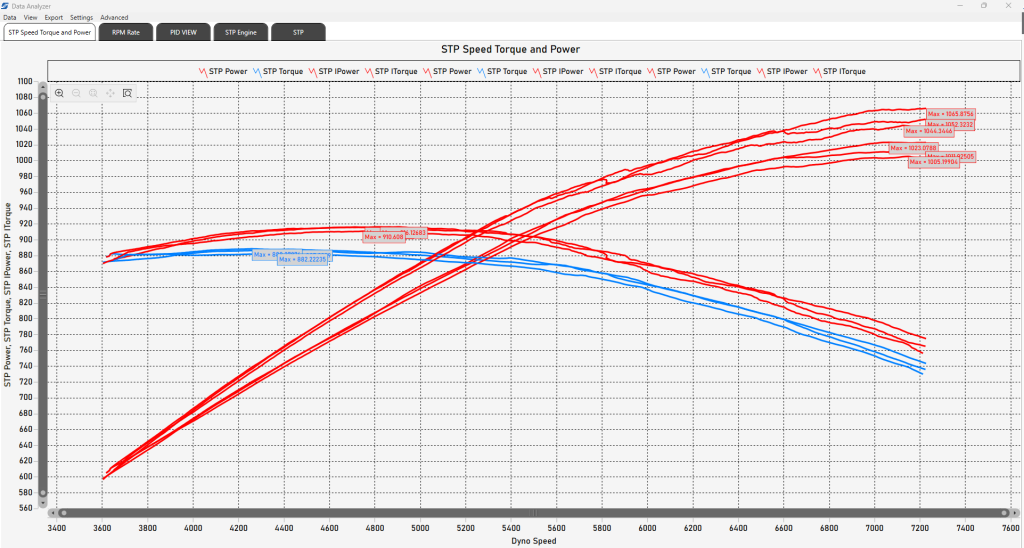
One of the primary advantages of steady-state automation is that it brings repeatability and efficiency to procedures that were traditionally performed manually.
Step Testing
A step test moves through a sequence of operating points using predefined increments and stabilization periods.
The test begins at a starting point and increases or decreases by a defined step size at specified time intervals. After each transition, the system stabilizes before recording data and advancing to the next step.
Step testing is frequently used to evaluate engine response across a range of operating conditions.
Typical applications include:
- Engine performance mapping
- Torque curve development
- Fuel consumption analysis
- Emissions characterization
- Calibration validation
- Baseline comparison testing
Fast step tests can often produce results comparable to long-duration steady-state testing while significantly reducing total test time.
Acceleration Testing
Acceleration testing is designed to simulate continuous transient events similar to real operating conditions.
Instead of moving through discrete operating points, the dynamometer continuously ramps from a starting condition to an ending condition at a controlled acceleration rate.
Common applications include:
- Transient engine response evaluation
- Turbocharger performance assessment
- Fuel delivery analysis
- Emissions behavior characterization
- Thermal response studies
- Load acceptance and recovery evaluation
In industrial applications, acceleration testing helps engineers understand how an engine behaves during rapidly changing operating conditions that are difficult to reproduce consistently with manual control.
Cyclical and Life Cycle Testing
Cyclical testing consists of repeated operating patterns executed continuously over extended periods.
These tests often combine steady-state and transient conditions within repeating loops designed to simulate real-world duty cycles or endurance conditions.
Common applications include:
- Engine durability testing
- Endurance validation
- Generator reliability testing
- Component lifecycle evaluation
- Production validation programs
- Break-in procedures
- Reliability studies
Cyclical testing is particularly valuable for OEM durability programs. By repeatedly exposing components and systems to realistic operating conditions, engineers can identify potential failure modes, validate design improvements, and establish expected service life.
Complex and Custom Automated Testing
Modern programmable test software allows engineers to create highly specialized automated test procedures tailored to unique applications.
These tests may combine:
- Steady-state sequences
- Transient acceleration events
- Conditional logic
- Automated pass/fail criteria
- Safety monitoring
- Branching workflows
Typical applications include:
- Production quality testing
- Automated warm-up procedures
- Progressive engine break-in
- Track or duty-cycle simulation
- Specialized research applications
The flexibility of programmable automation allows test facilities to design procedures that closely match real-world operating requirements.
Standardized Testing
Standardized tests are formal procedures defined by regulatory agencies, industry organizations, or government standards bodies.
Common applications include:
- EPA certification testing
- CARB compliance testing
- ISO test procedures
- Military specifications
- Industry-specific validation standards
- Vehicle type approval
- Component compliance validation
- Industrial quality verification
Standardized testing often requires certified equipment, controlled environments, and strict adherence to procedural requirements. Automated dynamometer systems play a critical role in ensuring these tests are executed consistently and accurately.
Choosing the Right Automated Test Method
| Test Type | Typical Application |
| Steady-State Test | Baseline mapping, BSFC analysis, and controlled data collection |
| Step Test | Torque curve development, fuel consumption analysis, and calibration validation |
| Acceleration Test | Transient response evaluation, load acceptance simulation, and emissions behavior analysis |
| Cyclical/Life Test | Durability, endurance, reliability, and lifecycle validation |
| Complex/Custom Test | Specialized workflows, automated pass/fail logic, and production validation |
| Standardized Test | Regulatory compliance, certification, and industry-standard verification |
Selecting the correct automated test approach depends on the testing objectives, required data quality, operating environment, and industry standards involved.
Data Acquisition and Advanced Test Automation
Modern automated dynamometer systems extend beyond simple test execution. Integrated automation and data acquisition platforms provide engineers with real-time access to hundreds of synchronized measurement channels, enabling deeper analysis of engine performance, efficiency, emissions, temperatures, pressures, and system behavior.
Advanced automation software can also incorporate conditional logic, automated pass/fail criteria, alarm handling, and report generation, helping organizations streamline testing workflows while improving data quality and traceability.
The Role of Automation in Modern Test Cells
As testing requirements continue to evolve, automation has become a foundational component of modern dynamometer facilities.
Advanced automation software helps facilities:
- Improve repeatability
- Increase throughput
- Reduce operator dependency
- Streamline workflows
- Improve data quality
- Support complex transient testing
Integrated automation and data acquisition platforms also allow engineers to analyze performance trends more efficiently and make faster development decisions.
For many organizations, automated testing is no longer simply a productivity enhancement—it is a necessity for maintaining testing accuracy, operational efficiency, and competitive performance.
Building More Efficient and Repeatable Test Programs
Automated dynamometer testing has become a foundational technology for OEMs, engine manufacturers, and industrial testing organizations seeking to improve data quality, accelerate development programs, and increase test cell productivity.
By combining precise control, repeatable execution, advanced data acquisition, and standardized procedures, automated testing helps engineering teams make better decisions with greater confidence.
As engine and powertrain systems continue to evolve, automation will remain essential for supporting validation, durability, compliance, and product development initiatives across a wide range of industrial applications.
Optimize Your Testing Environment with Power Test
From engine development and validation to production testing and durability programs, Power Test automation and data acquisition solutions help organizations improve repeatability, increase throughput, and generate reliable performance data.
Explore Power Test industrial dynamometer systems and advanced control platforms to learn how automation can enhance your testing capabilities.
Connect with Power Test to improve reliability, compliance, and test cell productivity in your test environments.